Stories · Palms · 7 min read
A field guide to the palms you will actually see
Coconut, date, Canary, royal, fan, traveller’s. Six palms, how to tell them apart from a sunlounger, and what each one says about where you are.
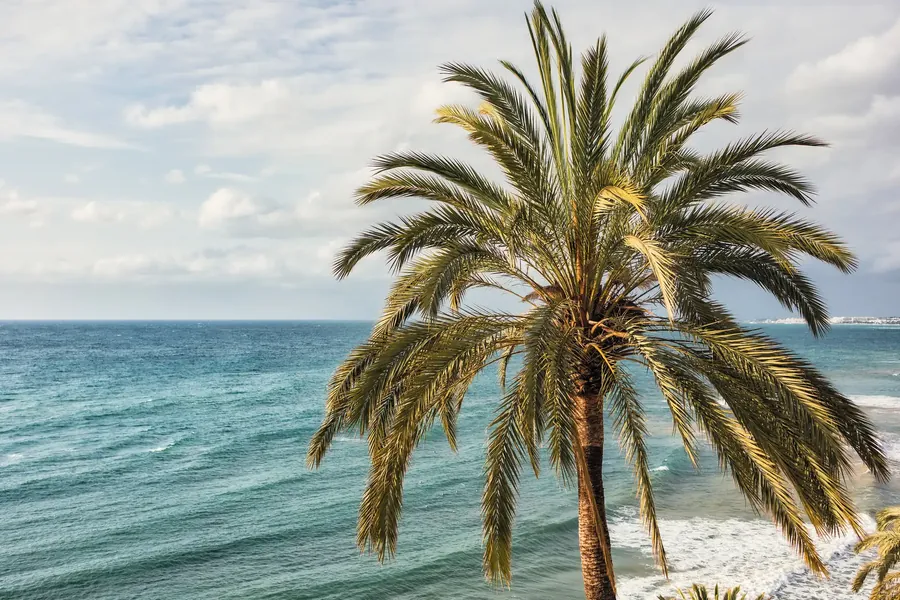
There are around 2,600 species of palm, and on a beach holiday you will meet about six. Once you can name them, every promenade turns into a story about who planted what and why. Take the palm quiz afterwards to check.
First question: feather or fan?
Palm leaves come in two shapes. Feather (pinnate) leaves have leaflets along a central stem, like a giant feather: coconut, date, royal. Fan (palmate) leaves spread from a point like an open hand: Washingtonia, the European fan palm, the Hawaiian loulu. Decide that first and you have halved the field.
Coconut palm (Cocos nucifera)
Feather. A smooth, usually leaning grey trunk, a loose crown, and coconuts. If it leans over a beach in the tropics, it is a coconut. It will not grow where winters dip below about 15 degrees, so a coconut palm means you are in the tropics or very close. Maldives, Bali, Sri Lanka, Zanzibar, the Caribbean, Polynesia.
Date palm (Phoenix dactylifera)
Feather. A straight trunk patterned with old leaf bases like a pineapple, stiff grey-green leaves and clusters of dates in late summer. The tree of oases and of the dry subtropics: Elche, Marrakech, Dubai, Palm Springs. Often grows several trunks from one base.
Canary Island date palm (Phoenix canariensis)
Feather. The date palm’s fat cousin: a thick trunk, a huge dense crown of dark green leaves, and a look of solid prosperity. The hotel-garden palm of the world, native only to the Canaries. Nice, Mallorca, Sicily, Madeira, Perth.
Royal palm (Roystonea)
Feather. A smooth grey trunk like concrete, often bulging in the middle, topped by a bright green smooth section called the crownshaft, then the leaves. The avenue palm of the Caribbean and Florida: Miami, Cartagena, Havana. If it looks like a column with a green cap, it is a royal.
Mexican fan palm (Washingtonia robusta)
Fan. Extremely tall and thin, with a small crown of fan leaves and often a skirt of dead leaves below. The palm of Los Angeles, of Málaga’s promenade and of every cinematic sunset. Fast growing, cheap to plant, which is why cities used it by the thousand.
European fan palm (Chamaerops humilis)
Fan. Short, clumping, with several stems and spiny leaf stalks. The only palm native to mainland Europe, wild on the coasts of Spain, Sicily and Sardinia. If you see a knee-high fan palm on a Mediterranean hillside, that is the one that was there before anyone planted anything.
Bonus: the traveller’s palm
Not a palm at all. Ravenala, from Madagascar, holds its leaves in a flat fan like a peacock’s tail. It appears in Mauritius, the Seychelles and every tropical hotel lobby, and it is related to the banana.
Keep reading
More from the notebook
Families · 6 min read
How to pick a beach for small children
Shade, shallow water, a lifeguard and a toilet within a hundred metres. The five things that matter more than white sand, and the palm destinations that have them.
Planning · 9 min read
The twelve month sun planner
Where to go for reliable warmth in each month of the year, from the Canaries in January to the Riviera in September.
Palms · 6 min read
Europe’s palm groves: sun without the long flight
Elche, Vai, the Riviera, the Canaries. The corners of Europe where palms grow in numbers, and why they are the easiest warm holidays on the map.