Stories · Palms · 7 min read
The Palm Belt: where palms grow, and what it tells you about the weather
Palms are picky. Draw a line around the places they survive outdoors and you have drawn a map of where a beach holiday works. This is the map behind everything on Palmiana.
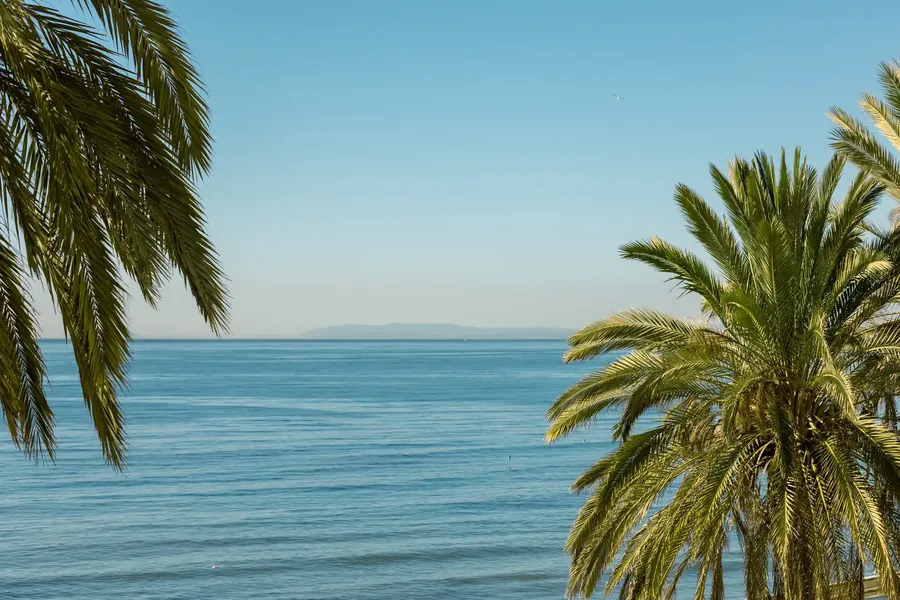
Every destination on this site sits inside a band that runs from roughly 44 degrees north to 44 degrees south. That band is not a marketing idea. It is the range in which palms grow outdoors without someone wrapping them in fleece every winter, and it happens to be the range in which you can sit outside in the evening for most of the year. I call it the Palm Belt, and the live map on the home page draws it for you.
Why palms are a weather instrument
Palms have no bark, no dormant season and no way to shut down for winter. Their growing point sits at the top of the trunk, exposed, and if it freezes the tree dies. So a mature palm outdoors is a certificate: this place has not had a killing frost in the tree’s lifetime. A coconut palm raises the bar further. It wants a mean temperature above about 21 degrees all year and gives up below 15, which is why coconuts fringe the beaches of Zanzibar and the Maldives and stop dead at the Canary Islands.
That gives you three rough zones, and they are more useful than any star rating:
- Coconut country, between the tropics: warm all year, humid, with a wet and a dry season instead of summer and winter. Bali, Sri Lanka, the Caribbean, Zanzibar, Polynesia. Pick the dry season and you get near-certain sun.
- Date palm country, the dry subtropics: Dubai, Marrakech, the Canaries, the Costa Blanca, Palm Springs. Hot summers, mild winters, very little rain. These are the winter sun destinations.
- The palm edge, the Mediterranean and its cousins: Mallorca, the Riviera, Sicily, Southern California, Perth. Real summers, real winters that stay above freezing, and a long shoulder season that is the best time to go.
The northern edge
The furthest north you will find palms growing outdoors in numbers is the Riviera, the Italian lakes and the south coast of England, where the Chinese windmill palm survives on the Gulf Stream. Those are not beach places. The practical northern edge for warm holidays is a line through Nice, Rome, the Greek islands and Málaga: above it you gamble with spring and autumn, below it you can plan.
The southern edge mirrors it: Perth and Sydney, Cape Town, Buenos Aires. Their summer is the European winter, which is why Australia appears on a site about sun at all.
How to use the belt
When you plan a trip, find the destination’s zone first, then its season. A coconut place in its wet season can be lovely and cheap, but you should expect an afternoon downpour. A date palm place in July can be dangerous for children and unbearable for everyone else. A palm edge place in November is a coin toss that often lands on sunshine, with empty beaches as the prize.
The best time explorer turns this into colours: choose a month and it ranks every destination on the map by how comfortable it is right then. The sun map shows where the sun is up this minute, which is a different kind of question and the one I ask most often.
Keep reading
More from the notebook

Nomads · 8 min read
Choosing your first sunny base as a digital nomad
Wifi, visas, cost and the people you will meet. The honest checklist for picking a warm place to work from for a month or a season.
Families · 6 min read
How to pick a beach for small children
Shade, shallow water, a lifeguard and a toilet within a hundred metres. The five things that matter more than white sand, and the palm destinations that have them.
Planning · 9 min read
The twelve month sun planner
Where to go for reliable warmth in each month of the year, from the Canaries in January to the Riviera in September.